

The Complete Guide to Selling a Rental With Tenants in MA
Selling a rental property with a nonpaying tenant feels like being stuck in a corner. The rent stopped two, three, maybe six months ago. The mortgage, taxes, insurance, and water bill didn’t. And you’re wondering if you even have the right to sell while someone is living there.
Most landlords assume they have to get the tenant out first. That’s not true in Massachusetts. You can sell. The real question is how, and which path costs you the least time, money, and stress.
This guide walks through tenant rights, the eviction process, and four ways to sell.
Quick answer: Yes, you can sell a rental property in Massachusetts even if the tenant isn’t paying rent. A sale doesn’t end the tenancy. The buyer becomes the new landlord and takes over the lease or tenancy at will, plus the security deposit. To remove a nonpaying tenant, the owner (you, or the buyer after closing) must serve a 14-day notice to quit and go through a court eviction. Changing the locks or shutting off utilities is illegal. Your main options are: sell with the tenant in place, finish an eviction first, reach a voluntary move-out agreement, or sell as-is to a buyer who takes over the tenant situation.
We’re a Massachusetts home buying company, not a law firm. This guide is general information, not legal advice. Massachusetts landlord-tenant law is detailed and changes often. Before you serve a notice or sign a sale agreement, talk with a Massachusetts landlord-tenant attorney.
Can You Sell a Rental Property in Massachusetts If the Tenant Isn’t Paying Rent?
Yes. Nothing in Massachusetts landlord-tenant law stops you from selling a rental property with a nonpaying tenant. You own the property, and you can sell it.
What you can’t do is sell the tenant out of their rights. When the deed changes hands, the tenancy stays put. The new owner steps into your shoes as landlord.
That means three things for a rental property sale:
- The tenant stays until their tenancy is ended the legal way.
- The buyer inherits the tenancy, including any lease, the security deposit, and the unpaid rent problem.
- Your pool of buyers shrinks. Most buyers using a mortgage to buy a home to live in want it delivered empty. Investors and cash buyers are usually the ones willing to take on a tenant who isn’t paying.
What Happens to the Tenant When You Sell?
It depends on what kind of tenancy you have. In Massachusetts, almost every residential tenant falls into one of two groups.
| Written lease | Tenant at will (month-to-month) | |
|---|---|---|
| Does a sale end it? | No. The buyer takes the property subject to the lease. | No. The tenancy continues with the new owner. |
| How can the owner end it without cause? | Generally can’t before the lease term ends, unless the lease allows it. | Written notice of 30 days or one full rental period, whichever is longer (G.L. c.186, §12). |
| Notice for nonpayment of rent | 14-day notice to quit (G.L. c.186, §11) | 14-day notice to quit (G.L. c.186, §12) |
| Tenant’s right to “cure” (pay and stay) | Can pay what’s owed, plus interest and costs, up to the court “answer date.” No yearly limit. | Can pay in full within 10 days of getting the notice, once every 12 months. If the notice leaves out this right, the tenant gets until the answer date. |
The security deposit and last month’s rent move with the property
If you collected a security deposit or last month’s rent, it goes to the buyer at closing, with any interest owed. Under G.L. c.186, §15B, the new owner becomes responsible for it and must tell the tenant in writing that they now hold it. The buyer can be on the hook even if the seller never handed it over. So expect any buyer, or their attorney, to ask for your deposit records.
Showing a tenant-occupied property
You can show the unit to buyers, but you have to arrange it with the tenant in advance. The Attorney General’s guide to landlord and tenant rights lists showings to prospective buyers as a reason a landlord may enter, with advance arrangement. Your lease may add its own notice rules.
Honestly, a tenant who isn’t paying usually isn’t eager to help you show the place. That’s one reason many landlords selling tenant-occupied property look for a buyer who doesn’t need showings at all.
What Are a Landlord’s Rights When a Tenant Stops Paying?
Your landlord rights are real, but they run through the court system. Massachusetts doesn’t allow shortcuts.
What you can do:
- Serve a proper 14-day notice to quit for nonpayment
- File a summary process (eviction) case in court after the notice period runs
- Ask the court for a judgment for possession and the unpaid rent
- Negotiate a written payment plan or move-out agreement
What you can’t do (even if you’re about to sell):
🚫 Change the locks 🚫 Remove the tenant’s belongings 🚫 Shut off heat, water, or electricity 🚫 Threaten or harass the tenant into leaving
These are “self-help” evictions, and they’re illegal in Massachusetts (G.L. c.186, §14 and G.L. c.184, §18). A landlord who tries them can owe the tenant damages and attorney’s fees. That can wipe out what you’d make on the sale.
How Does the Tenant Eviction Process Work in Massachusetts?
Here’s the general shape of an eviction for nonpayment of rent. Every case is different, so treat this as an overview, not a checklist to follow on your own.
- Serve a 14-day notice to quit. Massachusetts requires a specific state form to go with any nonpayment notice. It explains the tenant’s rights and where to find rental assistance. Many landlords use a constable or sheriff to serve it.
- Wait out the notice period. You can’t file in court until the notice period has passed. If the tenant cures (pays in full within their cure window), the tenancy usually continues.
- File a summary process case. This is usually filed in the Housing Court. The tenant is served with a Summons and Complaint, which sets the “answer date.”
- The tenant can answer. They can raise defenses and counterclaims, such as bad conditions in the unit, a defective notice, or retaliation.
- Mediation or trial. Many cases settle in court mediation with a payment plan or a move-out date.
- Judgment and execution. If you win, the court eventually issues an “execution.” A sheriff or constable can then carry out the move-out with proper notice.
You can find court forms, mediation programs, and self-help resources on the state’s Housing Court resources page.
Three things that can slow an eviction down
- A pending rental assistance application. If the tenant has applied for rental assistance (such as RAFT), Massachusetts law requires the court to pause a nonpayment case while the application is pending (G.L. c.239, §15). That’s not all bad news: if the application is approved, you may get a large share of the back rent.
- Repair problems. If the unit has code violations you knew about, the tenant may be able to withhold rent and counterclaim. Unpaid rent and an unfixed leak often show up in the same case.
- Retaliation. If you start an eviction within six months after a tenant reported code problems or took similar protected steps, the law presumes retaliation (G.L. c.186, §18). You’d have to prove otherwise.
All together, an eviction can take anywhere from several weeks to many months. That timeline is what drives most landlords’ decision about how to sell.
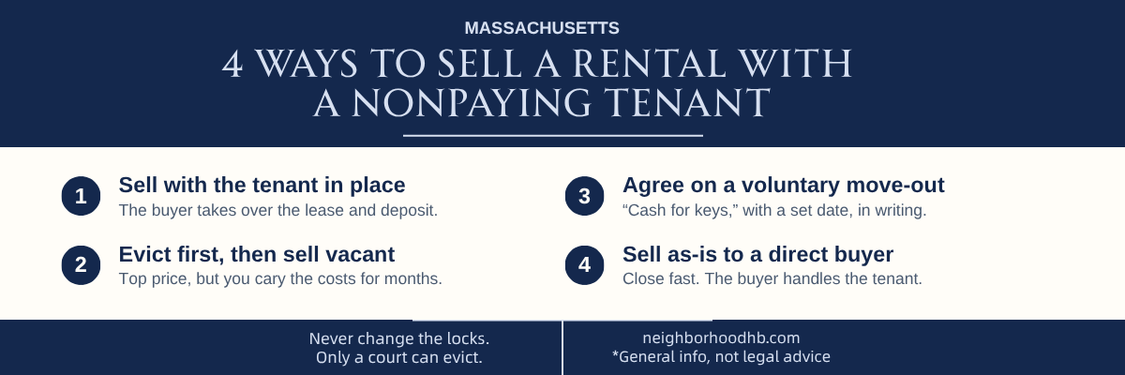
4 Ways to Handle Selling a Rental Property With a Nonpaying Tenant
| Option | How it works | Timeline | Best for |
|---|---|---|---|
| 1. Sell with the tenant in place | List to investors; buyer takes over the tenancy | Depends on finding an investor buyer | Multifamily owners in strong rental areas |
| 2. Evict first, then sell vacant | Finish the eviction, clean up, then list | Eviction time plus listing time | Owners who can carry costs and want top retail price |
| 3. Voluntary move-out (“cash for keys”) | Pay the tenant to leave by a set date, in writing | Often faster than eviction, if the tenant agrees | Tenants willing to negotiate |
| 4. Sell as-is to a direct buyer | A cash buyer purchases with the tenant in place and handles it after closing | Can close in days or weeks | Owners who want out now |
Option 1: Sell with the tenant in place
This works best for a two-family or three-family in a solid rental market. Investors look at rent rolls, though, and a unit producing $0 drags down the price. Expect buyers to ask for a ledger showing what’s owed, a copy of the lease, and the deposit records.
Option 2: Finish the eviction, then sell vacant
A vacant, cleaned-up property usually draws the most buyers and the highest price on the open market. The trade-off is time. You carry the mortgage, taxes, insurance, and utilities through the whole tenant eviction process, then through repairs and listing. Units often need work after a long nonpayment case. Our post on selling as-is in Massachusetts covers that repair-or-sell math.
Option 3: A voluntary move-out agreement
Some landlords offer the tenant money, forgiven back rent, or both, in exchange for leaving by a set date. This is legal when it’s truly voluntary. It works best when it’s in writing, ideally as a court-approved agreement if a case is already open. Have an attorney draft or review it. A handshake deal that falls apart leaves you back at step one.
Option 4: Sell as-is to a direct buyer
A direct cash buyer purchases the property with the tenant still there. After closing, the tenant becomes the buyer’s responsibility, including any legal process. You skip showings, repairs, and the court calendar. The trade-off is usually price: a direct buyer typically pays less than a retail buyer would pay for a vacant, fixed-up home.
If you’re weighing this path, our comparison of Massachusetts as-is cash buyers shows what to look for and what to avoid.
Other Rules to Check Before Your Rental Property Sale
A few more pieces of Massachusetts landlord-tenant law can affect a rental property sale. Ask your attorney about each one that fits your property.
- Local ordinances. Some cities, including Boston, Cambridge, and Somerville, have extra rules, especially if a buyer plans to convert units to condos.
- Tenant opportunity to purchase (TOPA). Lawmakers spent 2026 debating a bill that would let cities and towns give tenants in some multifamily buildings a chance to match a buyer’s offer. Check its current status before you list a multifamily.
- Lead paint. For homes built before 1978, federal law requires lead disclosures to buyers, and Massachusetts has its own lead law for rentals where young children live.
- Subsidized tenants. Section 8 and other subsidized tenancies have extra notice and eviction rules.
- Taxes. Selling a rental can trigger capital gains and depreciation recapture. Some investors use a 1031 exchange. A CPA can run your numbers
What Happens When We Buy a Rental With a Nonpaying Tenant
At Neighborhood Homebuyers, tenant-occupied properties are a regular part of what we buy. That includes tenants who aren’t paying. Here’s what that looks like from our side of the table.
- We buy as-is, tenants included. No showings to coordinate. No repairs. No waiting on a court date before you can sell.
- We take over the tenant situation after closing. Once we own the property, any notice, court case, or move-out agreement is ours to handle, through the proper legal process.
- We treat your tenants with respect. A tenant who stopped paying is often dealing with a job loss, a health problem, or a family crisis. We give people reasonable time to find their next place. If that doesn’t work, we follow the court process like any landlord must.
- We cover typical closing costs.
- We close on your timeline, in as little as 14 days, or later if you need it.
- We work with your attorney, including if you already have an eviction case open.
If you live in one unit of your two-family or three-family, our Housing Promise applies to you: we don’t close until you have your next home lined up.
Neighborhood Homebuyers has 20+ years of experience and has helped more than 500 Massachusetts homeowners, from the North Shore to the Cape. Plenty of them were landlords who were simply done.
No pressure. No lecture about what you should’ve done differently. Just a straight answer about your options, even if that answer is “keep it and finish the eviction.”
Inherited a rental with tenants still in it? Our guide to selling an inherited house in Massachusetts covers the estate side.
Common Questions
Can I sell my rental property in Massachusetts if the tenant isn’t paying rent?
Yes. You can sell a rental property with a nonpaying tenant in Massachusetts. The sale doesn’t end the tenancy, so the buyer becomes the new landlord. Removing the tenant still requires a 14-day notice to quit and a court eviction.
Does selling a house end a tenant’s lease in Massachusetts?
No. A lease or tenancy at will continues after the sale. The buyer takes over as landlord and must honor the lease terms until it ends or is lawfully terminated.
No. A lease or tenancy at will continues after the sale. The buyer takes over as landlord and must honor the lease terms until it ends or is lawfully terminated.
A 14-day written notice to quit, whether the tenant has a lease or is a tenant at will. Massachusetts also requires a state form explaining tenant rights and rental assistance to go with the notice.
Can I change the locks if my tenant stops paying rent?
No. Changing locks, removing belongings, or shutting off utilities is an illegal self-help eviction in Massachusetts. Only a court process can remove a tenant.
What happens to the security deposit when a rental property is sold?
The deposit, and any last month’s rent, transfers to the buyer with interest owed. The new owner becomes responsible for it and must notify the tenant in writing.
Can a tenant stop an eviction for nonpayment of rent?
Often, yes. A tenant can usually pay what’s owed within their legal cure window to keep the tenancy. A pending rental assistance application can also pause the court case.
Will a cash buyer purchase a house with tenants who aren’t paying?
Many will. Direct cash buyers, including Neighborhood Homebuyers, often buy tenant-occupied property as-is and take over the tenant situation after closing. Expect a lower price than a vacant retail sale.
Ready to Talk Through Your Rental?
If you’re thinking about selling a rental property with a nonpaying tenant, call us at (508) 409-CASH (2274). Tell us about the property and the tenant situation. We’ll lay out your options, including the ones that don’t involve us. No pressure, no obligation.
This guide is general information about Massachusetts law as of November 2026. It is not legal, tax, or financial advice, and reading it doesn’t create an attorney-client relationship with anyone. Neighborhood Homebuyers is not a law firm. Landlord-tenant rules depend on your lease, your city or town, and your tenant’s situation, so please talk with a Massachusetts landlord-tenant attorney before serving a notice, filing an eviction, or signing a sale agreement.
About the author: Courtney Tompkins is the Brand Manager at Neighborhood Homebuyers in Randolph, Massachusetts, with 10 years of experience in real estate. Neighborhood Homebuyers has spent more than 20 years buying Massachusetts homes as-is, including tenant-occupied rentals.